
















Your competitive intelligence agents are probably lying to your reps right now. Not on purpose. They just don’t know any better.
They’re citing pricing pages that 404’d six months ago. Pulling competitive context from calls recorded three years ago. Hallucinating competitor features that were deprecated before your last performance review. And because they sound authoritative, your reps trust them. Your leaders trust them. Nobody catches it until it’s in front of a buyer.
The real cost isn’t the bad answer. It’s what happens next. A rep walks into a competitive deal citing a feature that doesn’t exist anymore. A buyer catches it. The rep loses credibility, and usually the deal with it.
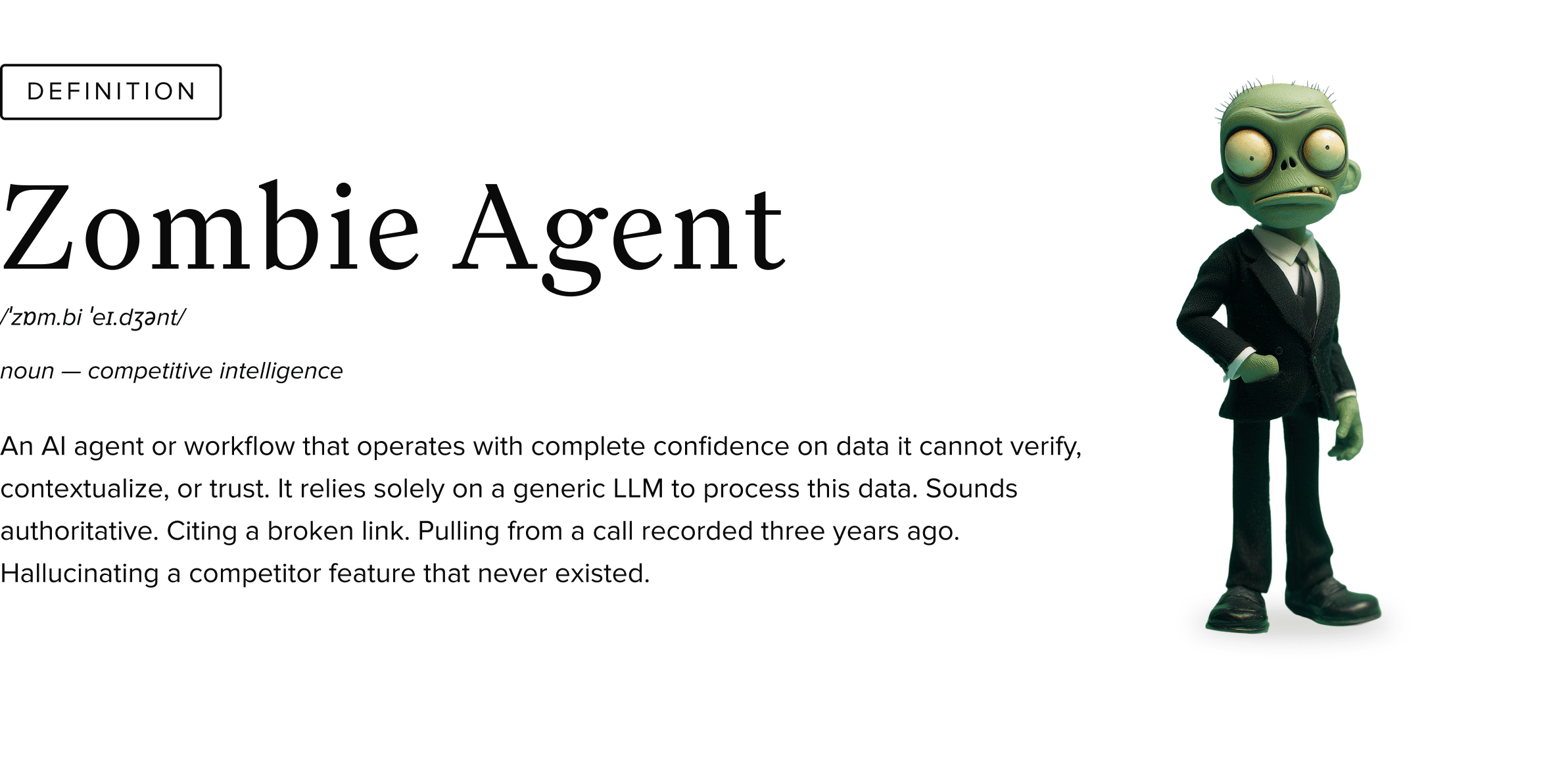
If your team is building AI workflows on raw data and a generic LLM, you almost certainly have an agent without a brain, aka a zombie agent.
The good news: this isn’t an AI problem. It’s a data foundation problem. And we have the antidote to the zombie agent takeover. You simply need to understand what’s actually missing from your stack.
The Two Layers Most Teams Skip
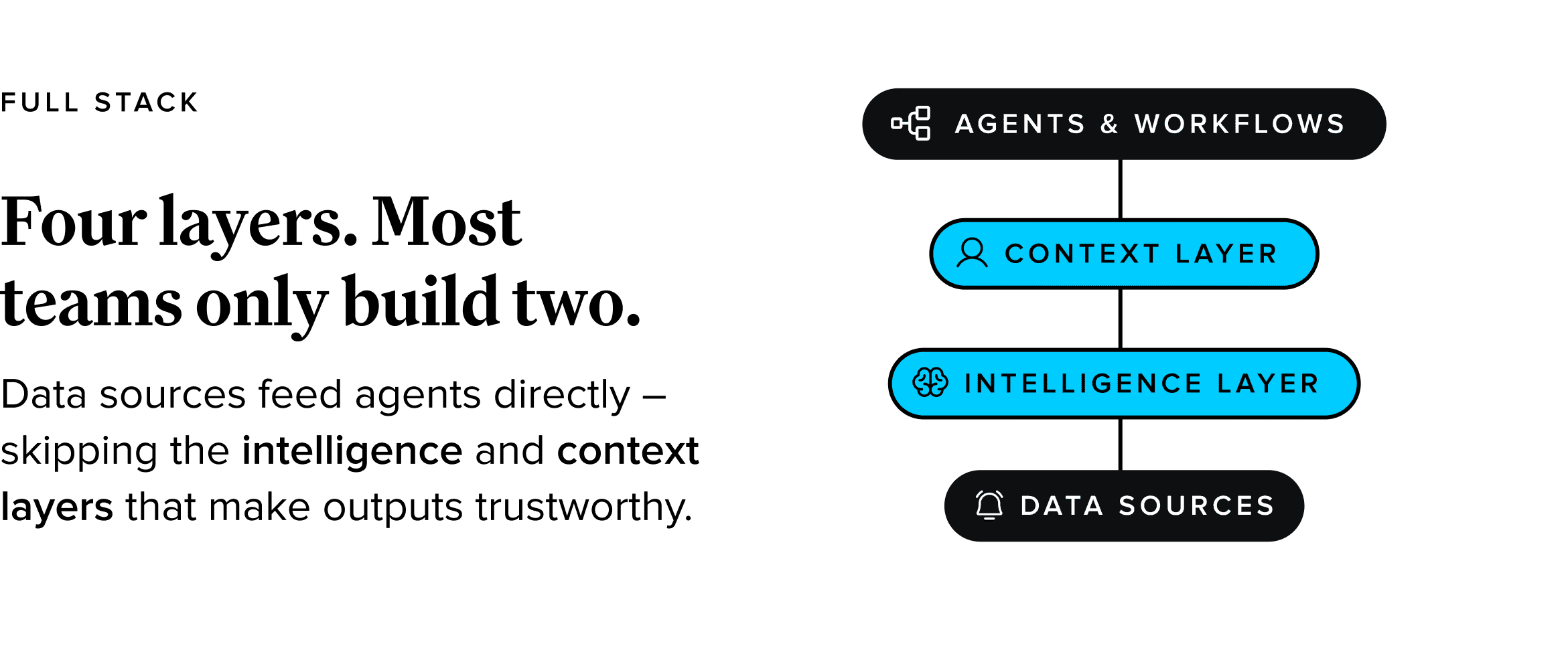
When teams build AI workflows, they typically think about two things: where the data comes from (calls, emails, CRM, win-loss interviews) and what the agents do with it (briefings, battlecards, answers, alerts). Data in, output out.
What gets skipped are the two layers in between. And they’re the ones that actually determine whether your agents are trustworthy or not.
Those layers are the intelligence layer and the context layer. Skip them, and you get a zombie. Build on them, and you get something that wins.
The Intelligence Layer
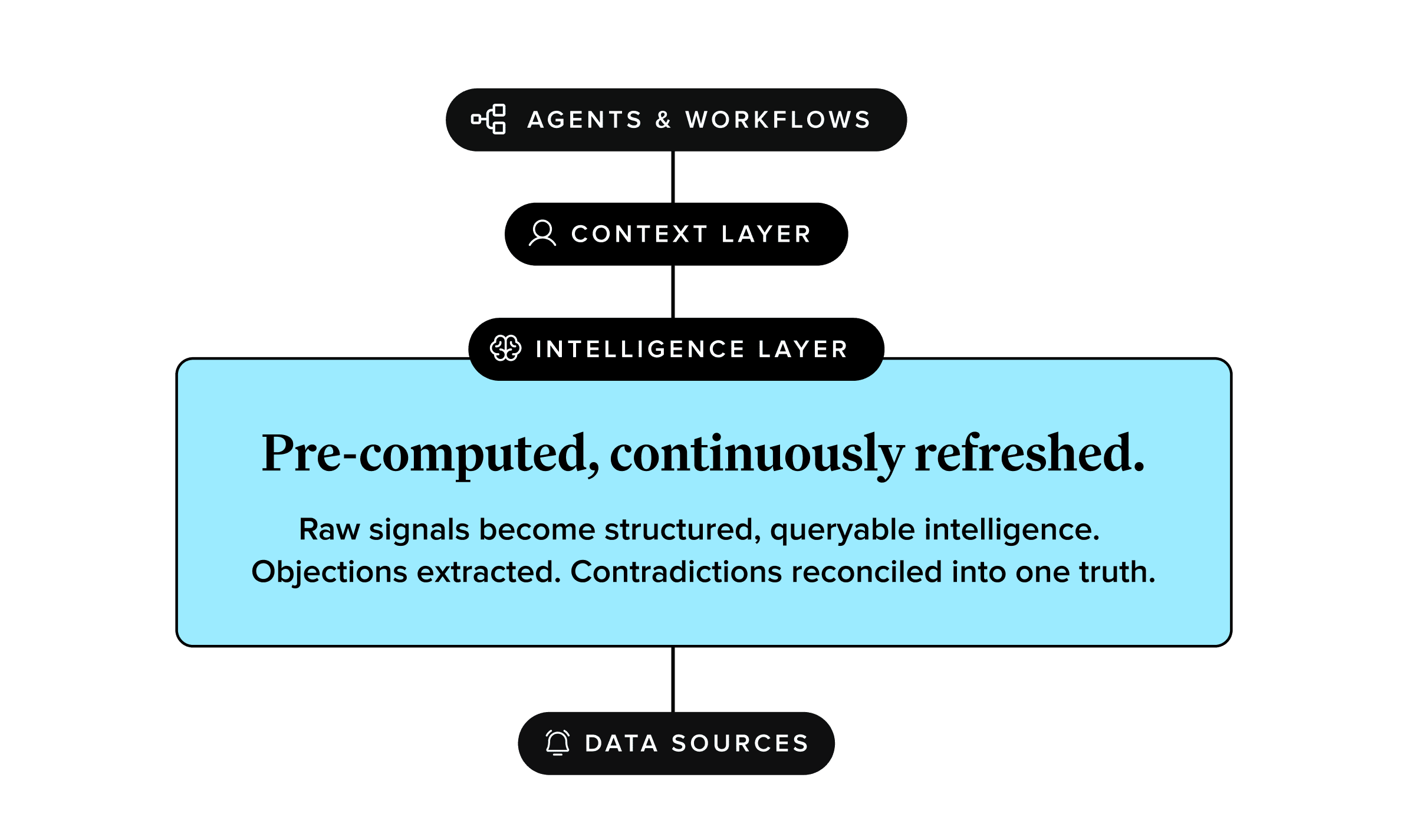
Most teams pipe raw data straight to their agents and call it done. But raw data is noisy, contradictory, and decaying by the minute. A call transcript from eight months ago might directly contradict one from last week. A competitor’s pricing page might have changed three times this quarter. A feature that reps are confidently citing in deals might not exist anymore.
For example, a company we work with recently found that generic LLMs were perpetuating false information about a lawsuit against one of their competitors. This was due to LLMs consistently citing articles by a single author who was falsifying the information entirely.
A generic LLM has no way to know this. It weighs a broken link the same as a verified source. It picks a side without telling you. Ask it the same question twice and you might get two different answers. These aren’t edge cases. They’re the default behavior of any agent built without an intelligence layer beneath it.
Mature competitive intelligence teams have recognized this pitfall and are adding an intelligence layer to their stack that parses through their data and presents something structured and trustworthy.
If you’re building or buying an intelligence layer today, here’s what good actually looks like:
Extraction and aggregation
Are your signals being processed or just collected?
It starts with how signals get processed. Raw sources like calls, emails, interviews, and CRM notes need to go through two distinct steps. First, extraction: pulling the specific quotes, objections, and talk tracks out of individual sources. Then aggregation: grouping those extractions together into coherent themes and scored insights. Most tools skip the second step entirely, which means your agents are retrieving fragments instead of truth.
Extraction accuracy
Is your agent pulling the right intel from each source?
A real intelligence layer reads context, not just keywords. It knows the difference between a competitor being named as a threat versus a partner. It accounts for bad transcriptions. It scores each extract on specificity and sentiment before it gets stored.
Retrieval quality
Can your agent find the right answer when it goes looking?
A generic LLM chunks everything, embeds it, and hopes retrieval finds the good bits. At 100,000 call transcripts, that produces millions of chunks and garbage retrieval. A generic system stores everything and hopes retrieval sorts it out. A well-built intelligence layer does the hard work at ingestion, scoring, attributing, and sorting extracts before you ever run a query. By the time your agent goes looking, it’s searching a curated pile, not a landfill. That means smaller, better-organized chunks that fit more signal into a context window and dramatically more accurate answers as a result.
Output consistency
Do all your outputs point to the same ground truth?
The last thing to look for is cross-output consistency. This one is underrated. If your deal summary says a competitor was in a deal for a specific reason, your win-loss analysis should reference the exact same underlying extract. Everything should point to the same ground truth. Systems that skip this end up with contradictions across their own outputs, and once reps start catching those contradictions, trust in the whole system collapses fast.
The practical test: can your agent answer a specific question about why you’re losing to a competitor, or what objections are showing up most in enterprise deals, with a sourced, structured answer? Or is it retrieving a loosely related chunk of raw transcript and hoping for the best?
This is the difference between an agent that sounds confident and an agent that actually is.
The Context Layer

Even well-structured intelligence drifts without expert context shaping it. Your team knows things that no data source captures: which objections are actually worth addressing, how aggressive to be in a competitive comparison, where a competitor is genuinely weak versus where they just appear weak. That kind of nuance doesn’t live in a transcript. It lives in your people.
This is what a good context layer does. When a human corrects an answer or adjusts how something is framed, that edit shouldn’t just fix one output. It should inform everything the system generates going forward. The system learns from how your experts think, not just what your data says. Set direction once, and it carries forward automatically.
The tricky part is scope. A correction to one deal tip should probably stay narrow. A correction to how you position against a key competitor should probably propagate everywhere. Getting that balance right, knowing when to generalize and when not to, is what separates a real context layer from a system that just lets you edit things one at a time.
The Full Data Foundation In Practice
When all four layers are working together, the agent layer finally does what it promised. A rep asks why they’re losing to a specific competitor. The agent pulls from structured, reconciled intelligence, not a pile of raw transcripts. The answer is sourced, specific, and shaped by what your team has already verified. A deal tip fires before a call. A weekly briefing lands in Slack that actually reflects what’s happening in the market this week. A custom agent answers questions through whatever tool your team already lives in.
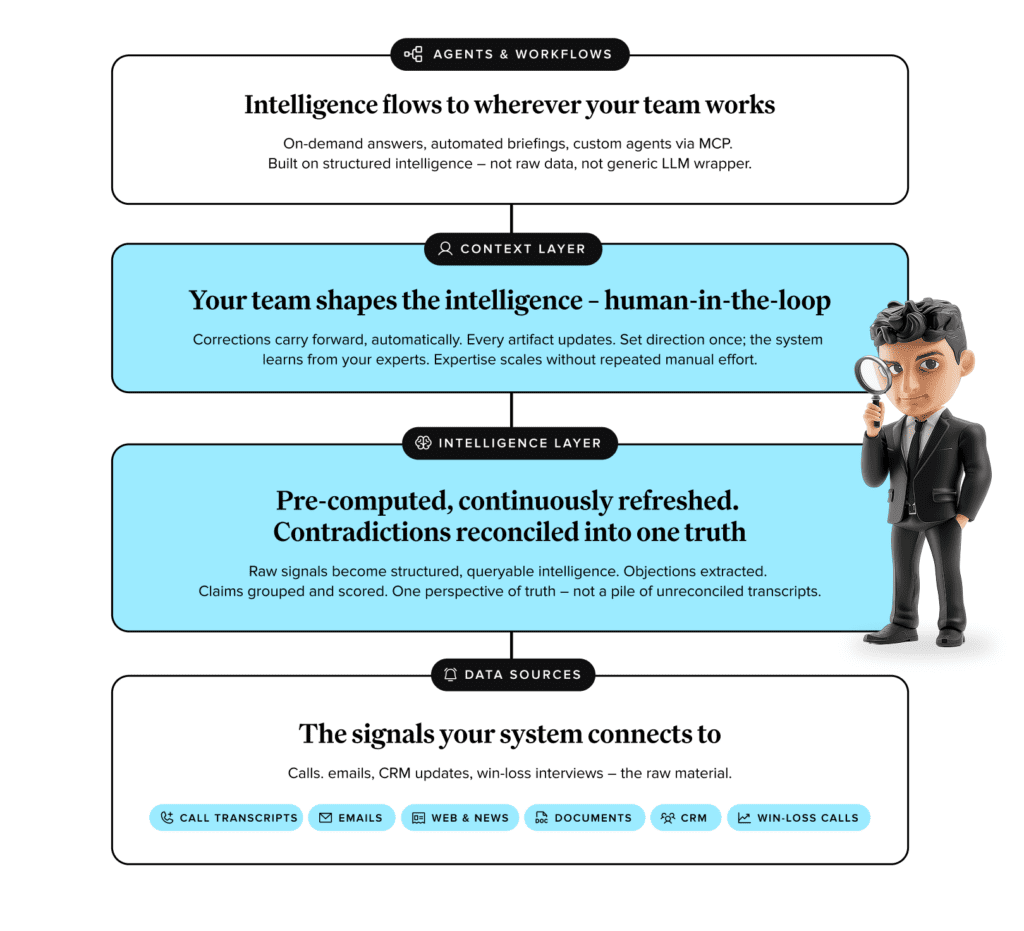
None of that is possible if you skip the middle. The data sources feed the intelligence layer. The intelligence layer feeds the context layer. The context layer shapes everything the agent touches. Pull out any one of those layers and the whole thing degrades, quietly and confidently, into a zombie.
Why Foundation Beats Speed
The race to agents is real. Every GTM team is building. The pressure to ship is intense. But speed without foundation is how you end up with zombie agents destroying the credibility you’ve spent years building, one confident, wrong answer at a time.
Every zombie agent answer that reaches a buyer is a trust withdrawal you didn’t authorize. A rep caught citing stale pricing. A battlecard that contradicts what the buyer already knows. These aren’t hypotheticals. They’re happening in your pipeline right now, in deals you think are going well.
The teams that win won’t necessarily be the ones who moved fastest. They’ll be the ones who asked the right question before they started building: what are my agents actually built on?


SHARE THIS POST