





You’re a sales rep with a call in an hour on a deal you last touched earlier that week. You know there’s some competitors in the mix, but you don’t remember which one said what, and you’re not quite sure what the buyer told you mattered most on that last call.
Traditionally, competitive sales enablement has come down to two options in this scenario, and neither one works.
Why the old ways of competitive sales enablement don’t work
Option one: ping the PMM. They drop whatever they’re doing, dig back through the call recordings in Gong, and try to reconstruct enough context to give you something tailored. If they’re fast, you get an answer in an hour. If they’re slammed (and they’re always slammed) you’re walking into that call with whatever you could piece together yourself.
Option two: go solo. You pull up the battlecard in the enablement folder, grab the generic differentiators that are supposed to work against that competitor in general, and hope they land. Except your buyer already told someone on your team, on an earlier call, exactly what they care about… and it isn’t necessarily what’s on the slide. You risk walking in off-message, with talking points that are technically accurate and completely untailored to the person on the other end of the call.
One costs you time and someone else’s afternoon. The other costs you accuracy and personalization. Neither one is fast and right.
Here’s the third option: you can get competitive sales enablement built from your PMM’s actual vetted competitive intelligence, personalized to the specific deal you’re in, without waiting on anyone and without falling back on a one-size-fits-all battlecard.
Sounds too good to be true? Well, we’re going to walk through how you can do it with Klue in minutes.
Three steps for sales reps to get personalized competitive deal support with AI
This is what that looked like on a real (illustrative) deal:
- Ask for the recap. Get the deal’s competitive threats and buyer requirements, pulled from the CRM and the actual call, courtesy of Klue’s MCP server.
- Ask for the comparison. Get a comparison built around what this specific buyer said mattered, the named competitors actually in this deal, and how you differentiate against them.
- Ask for the follow-up. Get a differentiated follow-up with that comparison attached, ready to send.
Step 1: “Get Me Up to Speed”
Firstly, you need to get back up to speed on the deal since you’ve talked to dozens of buyers since the initial demo. The prompt:
“Tell me about our Meridian Senior Living deal, the competitive threats present, and key buying requirements.”
Klue’s MCP (which connects with any LLM your business uses) does three things here: finds the opportunity in your CRM, identifies competitors, and pulls buyer requirements.

The answer comes back with a rundown of the deal, competitors present, including their incumbent solution.
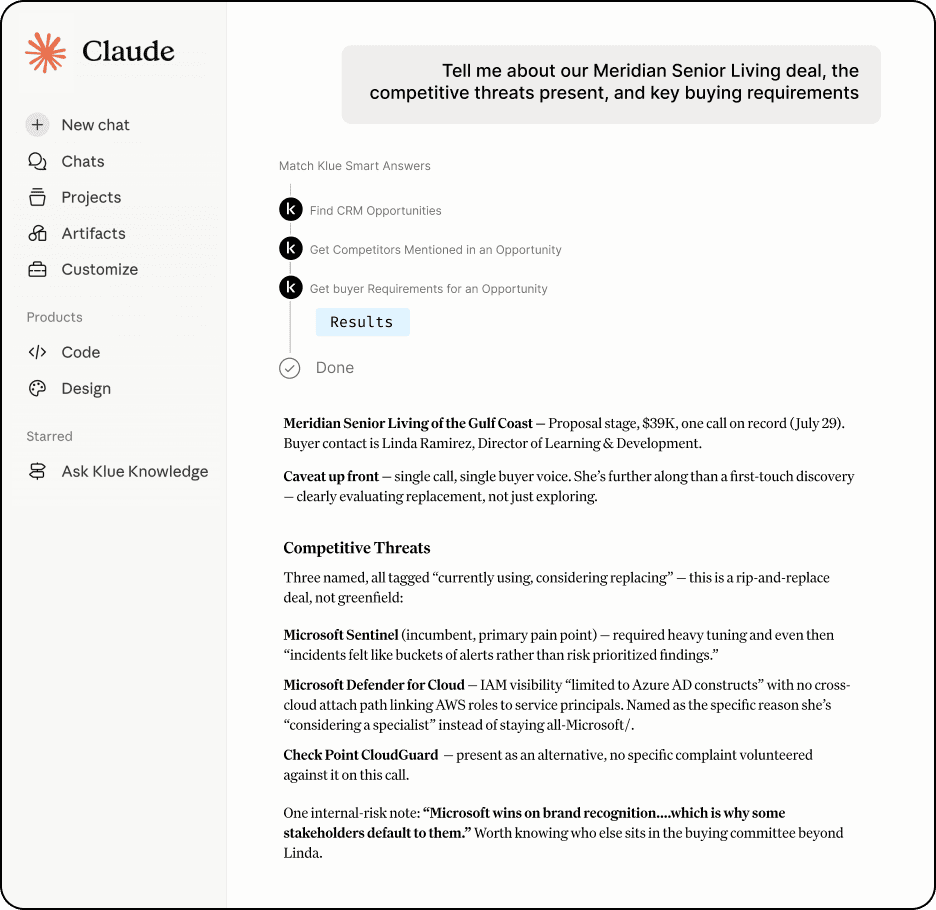
Then Klue provides the buyer’s own stated priorities, ranked by how hard they’d pushed each one.
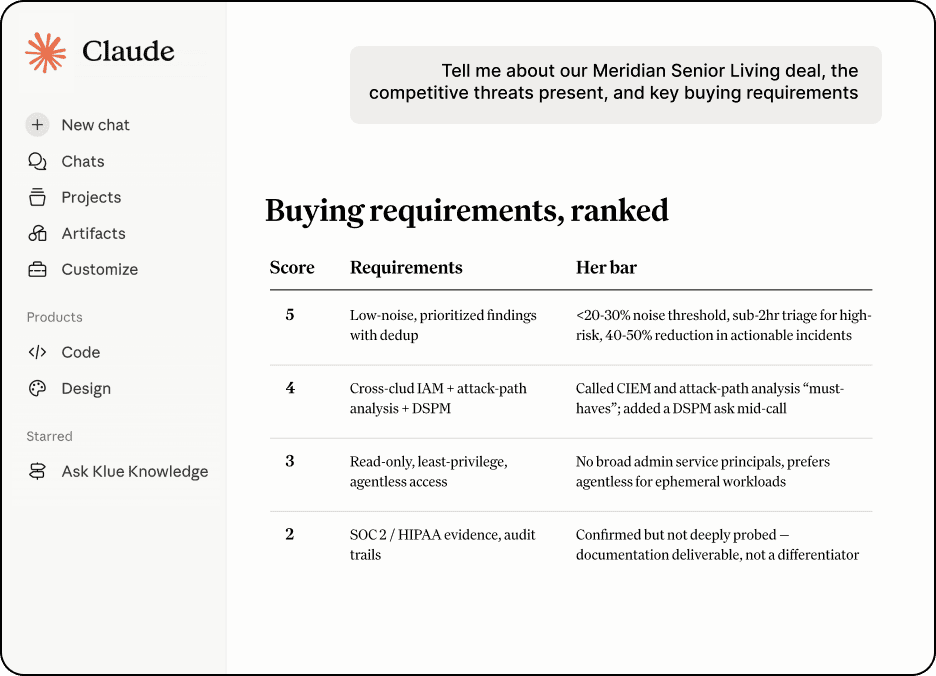
This last part is what a generic battlecard can’t give you. With an understanding of what matters to your buyers, you can prioritize your value wedges accordingly.
Step 2: “Build Me Something I Can Actually Send”
With this context, a seller can now build collateral and make the moves you need to proactively deposition the competition. For example, in your next prompt:
“I have another call coming up with Meridian Senior. Tell me where we can win against the incumbent Microsoft Sentinel based on the buyer’s needs, and put together 2 slides that I can bring into that call”
These quick slides reaffirm your unique value, mapped to the buyer’s needs. At Klue, we like to call these slides “Unique to Klue, and Important to You”; a mainstay of competitive sales collateral.

Above Klue provides the rundown on where you can win this deal. This is based on verified and vetted competitive intel from your product marketing or CI team, and not just whatever your LLM has scraped from the internet.
From there, you have two slides to share with your prospect ahead of the call:

Step 3: Write a differentiated, personalized email
Now, you can get this asset to your buyer ahead of the call to cement where you stand out. Last prompt:
“Write me a differentiated email ahead of this call and attach the slides.”

Now, you’ve gone from “what the heck was happening in this deal” to “buyer, this is what I heard mattered to you and how we uniquely solve your problem” in a matter of minutes.
A faster and more scalable way to support competitive deals
In an AI world, sellers don’t want the one-size-fits-all battlecard of old. They want deal-first intelligence — what to do in this deal, with this buyer, against these competitors.
And because it’s pulled from Klue — the same single source of truth your PMM already vets, validates, and keeps current — nobody’s trusting a black box. You’re getting the same intelligence your product marketing team would hand you themselves, just available through existing integrations the moment you need it instead of whenever they’re free.
Sellers get answers they can trust, fast. PMMs get their time back for the strategic product marketing work only they can do.
Want to see how Klue can help you win every competitive deal you’re in? See it in action here.
Note: The deal names, quotes, and numbers below come from a demo environment built specifically to illustrate this workflow — not a real customer engagement. Everything else — the prompts, the outputs, the way the tools connect — is exactly how Klue’s MCP works in production with any LLM.


SHARE THIS POST