If you’re a Major League baseball fan like me, you’ve seen a metamorphosis take place in virtually every aspect of the game over the last twenty years. Teams are no longer run by tobacco-chewing lifers who rely on gut instincts to evaluate opposing teams. Instead, they hire number crunchers who pore through data to come up with the optimal way to pitch each batter, where fielders need to be positioned, and how to approach opposing pitchers. They leave as little as possible to chance, mostly because they know it’s the only way to stay ahead of the competition.
The same is true for B2B technology companies.
Twenty years ago, it may have been OK to have a junior product marketer scrape web pages or ask around for information on competitors, but the game has changed a lot. Now companies are looking for actionable data to inform go-to-market strategies, prioritize product roadmaps, and enable sales teams more effectively. As a product marketing leader, I’ve done this by increasing the importance of competitive analysis for myself and my teams, and incorporating an increasing number of options to do the job well, including the use of thirdparty win-loss analysis.
The baseline for most competitive functions is to collect, format, and share competitive information to their sellers. While some companies do this manually, I love Klue for this purpose because it’s so easy to crowdsource competitive data, share it in an engaging way, and incorporate it into the various systems sellers use every day. But Klue can’t tell you what your buyers are saying; you have to supplement your competitive enablement approach. Here are three steps you can take to bring your competitive enablement to the next level
The advantage to a third party is that they are experts in the field, they’re able to elicit more unbiased feedback, and know how to turn the analysis into actionable information via analytics tools and executive summaries that can be shared directly with your senior leadership.
There is no perfect solution, but I’ve found third-party win-loss analysis to be the most effective because they provide the most comprehensive, unbiased information. In turn, this candid feedback can inform a variety of your organization’s decisions.
Generally speaking, win-loss vendors offer two kinds of data sets for their customers:
- Survey data–collected from hundreds or thousands of buyers–makes it possible to see trends from a large pool of responses. Even if response rates are low, there is typically enough data to overcome the law of small sample sizes
- Buyer Interviews conducted by win-loss analysts–typically ½ hour or so–provide enough time to elicit detailed feedback on key areas that the organization cares about. These interviews are typically conducted with a relatively small number of companies, say forty or fifty over the course of a year and cover why deals won or lost, competitors involved, evaluation criteria, product functionality, and more.:
While each interview is qualitative and anecdotal on its own, the data begins to build up over time, providing more of a critical mass that can be incredibly helpful for a company. It’s noteworthy that you can ask for different kinds of analysis, including new logos, upsells, renewals, etc. I’ve always done win-loss with new logos, and focused on deals with competition, but it’s a matter of your priorities.
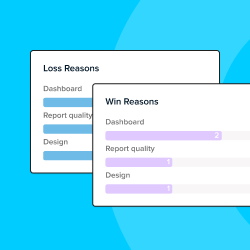
A good win-loss vendor will not only provide transcripts or even abstracts, but will also tag their data and make it available for slicing and dicing, or even exporting into other platforms such as Klue.
Of course, all of this information is critical not only for competitive analysis, but for helping Product prioritize roadmap items, seeing how go-to-market approaches align with what buyers are looking for, identifying opportunities to improve the buyer’s journey, and informing best practices during the sales process: everything from the best trap-setting discovery questions to tips for performing more effective demos.
Win-loss plays into a cogent competitive strategy in a few key ways:
- Competitive intelligence, heard directly from your buyers. With this information, you can enable your salespeople with valid, customer-driven information.
- Customer quotes and proof points. Good win-loss vendors provide useful analytical tools, and even have tight integrations into third-party products for additional use. While these win-loss interviews are typically confidential, some of the anonymized quotes that come from them can be incredibly powerful when incorporated into Klue cards, for example, helping sellers home in on hot-button areas that will resonate with their buyers.
- Executive summaries. Supporting leadership with aggregate themes for competitive insights; W/L gives PMM/CI a way to provide value to Exec Leadership through learned ‘themes’ executive summaries.
- Sales process improvements. You may learn that your demos are done too early or aren’t tailored to specific buyers, or find that your salespeople aren’t doing sufficient discovery. Knowing what’s working or needs attention will help you improve processes that can drive productivity improvements.
- Product roadmap. You may think you know that your customers want–or what’s most appealing about your competition–but there’s no better way to set roadmap priorities than hearing from buyers what’s most important to them.
I’ve found that effective win-loss analysis drives significant change in the way a company goes to market and competes. For example, we’ve been able validate several field observations, convincing key stakeholders to make material changes. In one instance, my company had a particularly low win rate against one vendor, and our Product team was hard at work to prioritize new features to make us more competitive. We focused several win-loss interviews on that competitor and learned that the vast majority of losses occurred because sellers were focused on a use-case outside our go-to-market strategy. Armed with this information, we worked with sales leadership to improve our enablement programs and helped sellers do better qualification, back out of deals that weren’t a fit, and compete more effectively in deals that we could win. We then saw a marked improvement in win rates against that competitor.
Another area of value is sharing evidence back to our Product team about the roadmap priorities, ensuring product plans aligned with customer needs.
Of course, there’s plenty more you can do outside of win-loss analysis to improve the impact of your competitive programs:
- Make sure you’re capturing all of your competitive deals in your CRM and building dashboards to do in-depth analysis. Don’t trust sellers to do this on their own.
- Interview sellers and other stakeholders at the conclusion of some key deals to gather your own insights.
- Conduct periodic meetings with focus groups among revenue teams to hear what they’re seeing. This will help you deliver better competitive enablement.
- Create visibility across the organization about what’s going on in the market to influence strategic decisions across departments.
- Work with Customer Marketing to get feedback from CAB sessions, usergroup meetings, and other customer interactions.
- Use CRM and other data to measure before and after to understand the impact of your efforts
One final note: Win-loss vendors tend to be expensive, and there’s almost always a tradeoff when you choose less expensive options. While it may be a big chunk to spend–especially in a tight economy–there aren’t many investments that provide more obvious business value than an effective win-loss vendor. The company with whom I’ve had the most success is DoubleCheck Research. They’ve been great to work with, and I’ve found their insights to be invaluable. You should always consider your options, but they’re one I endorse wholeheartedly