Imagine it’s 1:00 AM in Chicago.
A sales rep is about to walk into a meeting at a massive warehouse in Poland. The prospect is ready to talk, the deal is on the line, and the rep desperately needs a highly specific competitive answer right now.
But the person who holds that answer is fast asleep.
If you run competitive intelligence solo for a global organization, the math is entirely against you. Every time you log off to recharge, a seller in another time zone is left guessing.
Zaven Gabriel, Sr. Product Marketing Manager at Locus Robotics, knew he had to build a virtual extension of his PMM expertise. This is the story of how Locus Robotics used Klue’s Compete Agent to turn a massive bandwidth problem into their highest competitive engagement in a year.
Locus Robotics operates in a highly competitive, deeply technical space. Zaven is a team of one, actively juggling strategic PMM tasks and managing competitive content for up to 20 published competitor boards.
Keeping that much detailed, technical info up to date is a heavy lift. But the bigger bottleneck was distributing that intel acrosstime zones to a field team managing more than 350 customer sites globally.
Zaven desperately needed a way to ensure his reps were never flying blind, even when he was off the clock.
Zaven turned to Klue’s Compete Agent and got the guidance needed to train it to act as a trusted virtual extension of himself.
He fed Klue’s knowledge base specific details about Locus’s target personas, their industry categories, and how they position themselves.
Now when sellers ask a question, they are getting an answer that communicates in the Locus voice, vetted through Zaven’s judgment.
Once Zaven officially announced Compete Agent to the Locus sales team and demoed how to use it, the impact was immediate.
Not only are sellers adopting the tool rapidly to self-serve, but Zaven has also noticed a behavioral shift. By reviewing the query logs, he sees that the sales team is actively learning to ask better, more specific, and broader questions.
At a recent board of directors meeting, Zaven was asked to present how he uses AI to make his day-to-day job better. He showcased two highly specific use cases that prove the difference between raw data and deal-ready competitive intelligence.
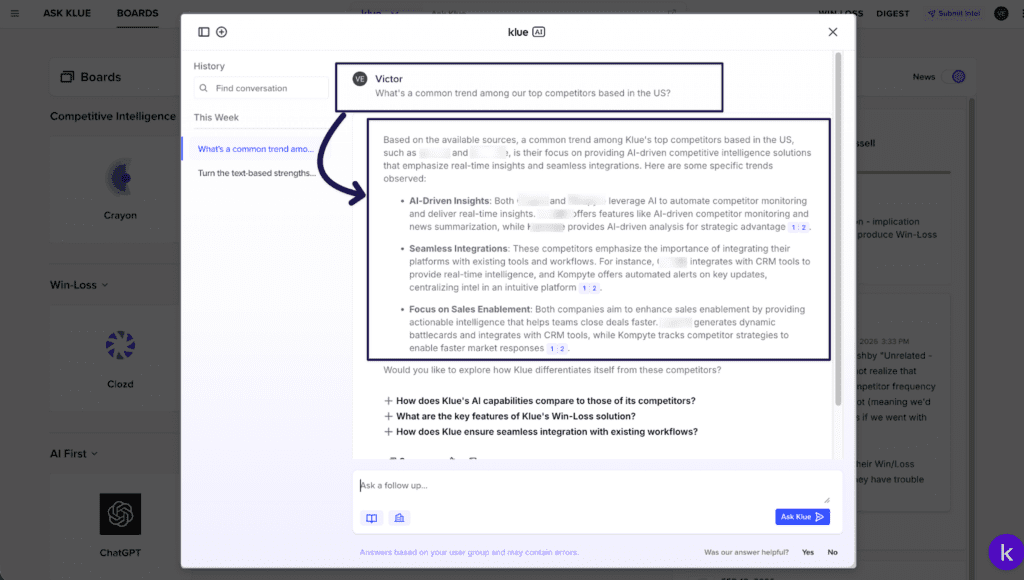
A seller is heading into a live presentation at a warehouse where Wi-Fi is notoriously unreliable. Within the Klue app, Zaven posed as the salesperson and asked Klue’s Compete Agent: “What are our biggest strengths against competitor X?”
After it generated strong talking points, Zaven took it a step further: “Could you please generate me a slide friendly comparison chart focusing on point A, point B, point C.”
It did exactly that. The seller now has a formatted, ready-to-use chart going into the meeting, completely bypassing the need to wait for Zaven to wake up.
Early in a sales cycle, prospects are often cagey about naming specific competitors. In Locus Robotics’ case, they might say they are considering “goods to person” systems, an entirely different category of automation featuring about a half-dozen major players.
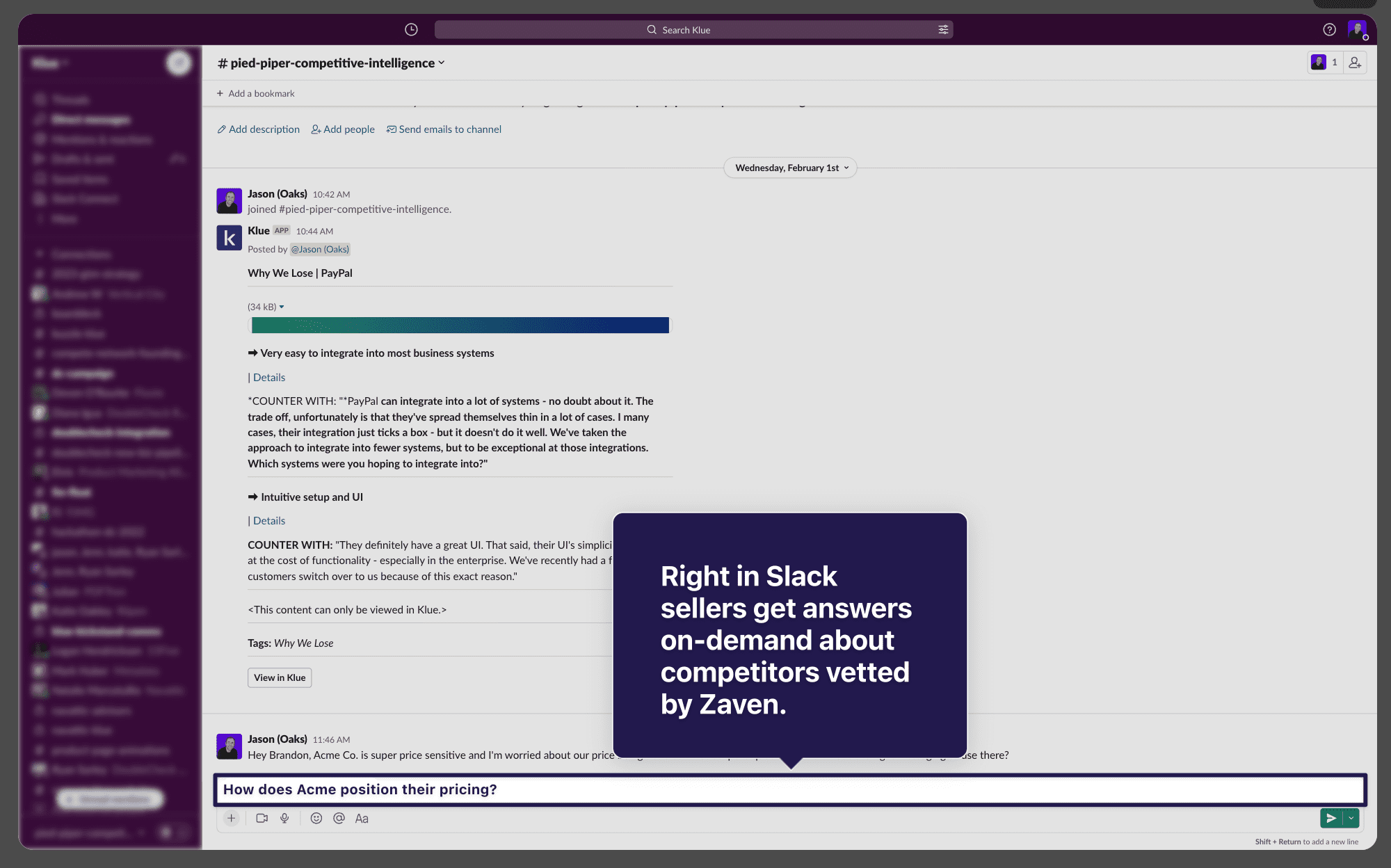
Traditional battlecards are organized by specific company names. Instead, Zaven went into Slack and asked Klue: “what are Locus strongest points against goods to person in general?”
Klue analyzed all competitors within that category, found the common patterns in how Locus positions itself against them, and synthesized those commonalities into solid talking points.
You can experiment with generic tools like ChatGPT or Copilot and give them some context. However, a general-purpose AI will never match a system built with deep competitive domain expertise.
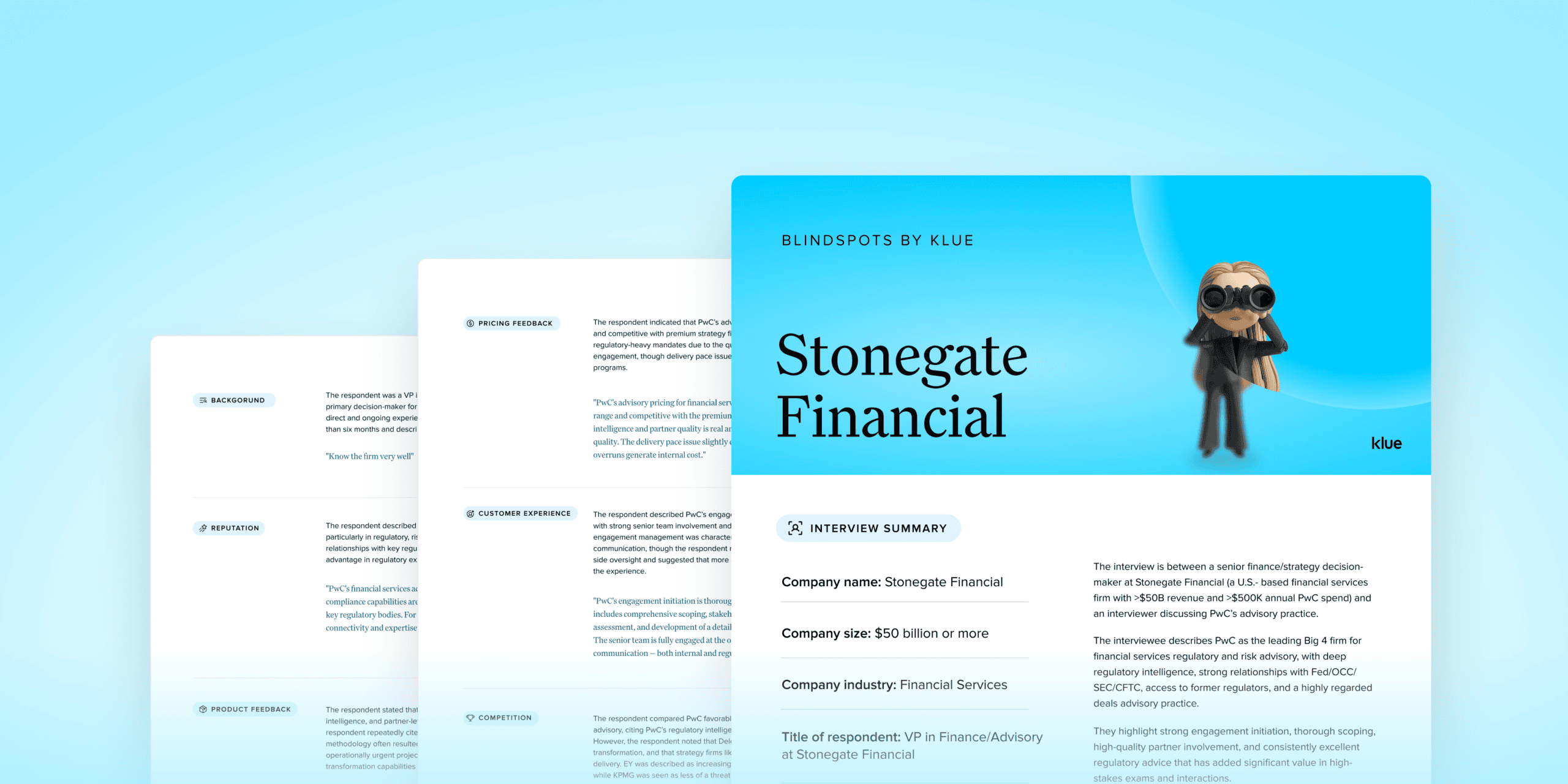
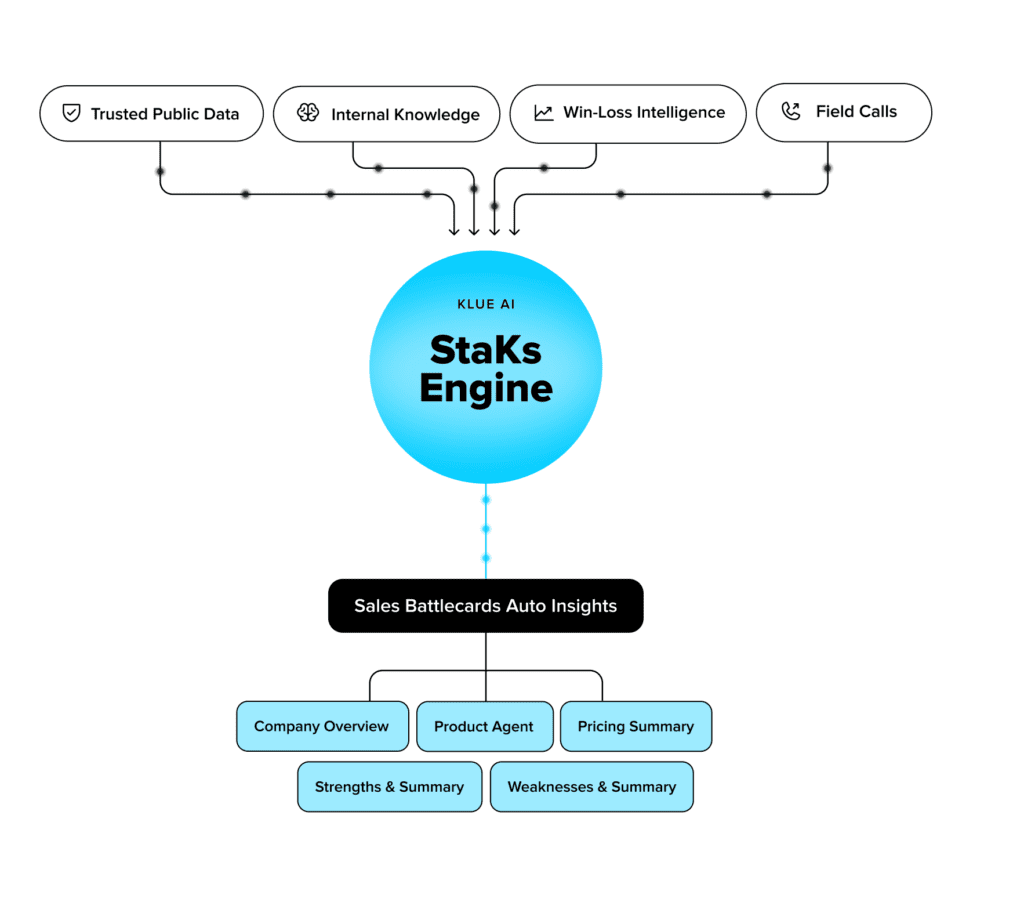
Klue understands the Locus personas, positioning, and corporate voice because it directly walks you through that onboarding. The StAKs Engine behind generating all outputs is built on Klue AI’s 10+ years of competitive intelligence domain expertise. Here’s what that looks like for the AI sales battlecards Klue helps Zaven curate and make available to his global sales team:
The biggest shift is what this means for Zaven’s own workload.
Maintaining deep, technical arguments for up to 20 distinct competitors is incredibly taxing. Zaven uses Ask Klue’s Research Mode to analyze the competitor profiles he previously bootstrapped.
He then uses Compete Agent to extend that research, keeping his massive knowledge base up to date with far negligible manual effort.
Zaven is freed from being a reactive human search engine. He’s now the strategic editor and orchestrator of a competitive engine that runs around the clock.
Locus Robotics is the global leader in revolutionary, enterprise-level, warehouse automation solutions. Their powerful, intelligent, and dynamically scalable autonomous mobile robots (AMRs) operate collaboratively with human workers to dramatically improve piece-handling productivity and throughput while optimizing labor and making efficient use of warehouse space. Their core products include LocusONE, Locus Origin, and Locus Vector, and the count giants like DHL, Ryder, and Maersk as clients.