














“We know our competitors.”
I hear this from leadership all the time. And sure, everyone can name the three to five companies they constantly run up against in their industry. You probably have their logos memorized.
But how well do you actually know them?
Because, ultimately, the depth of your knowledge dictates your success. The extent to which you understand a single competitor determines whether you can build enablement assets that reps can actually use to win deals involving that specific rival.
When an Account Executive pings you at 11:30 PM the night before a massive discovery call asking, “How do I win a deal against this specific competitor, now?”—knowing the rival’s tagline and scanning their pricing page will not help. For deep, active, deal-winning intelligence, depth is all that matters.
Here is how you zoom in to achieve that depth and build an analysis your sales team actually trusts.
What is a competitor analysis?
A competitor analysis is the focused process of dissecting a single rival company to uncover their specific product gaps, pricing strategies, and active sales tactics. You isolate one exact threat to find the vulnerabilities your sales team can exploit in live deals today.
While the terms frequently blend together in casual conversation, dissecting one specific threat requires a completely different approach than mapping your entire industry’s competitive analysis:
| Dimension | Competitor Analysis (Zooming In) | Competitive Analysis (The Broad View) |
| Primary Goal | Win the active deal in front of you | Map the overall market landscape |
| Focus | One specific, high-priority rival | All direct, indirect, and alternative solutions |
| Key Deliverables | Verbatim talk tracks, objection handling, pricing traps | High-level positioning, SWOT analysis, market share |
| Core Audience | Sales reps and account executives | Executive leadership and product teams |
| Update Frequency | Continuous, driven by live deal feedback | Quarterly or bi-annually |
How to do a competitive analysis for top rivals
A great analysis does absolutely nothing if it sits in a Google Drive folder gathering digital dust. And if you want to stop acting as a human routing machine for competitive questions, you must build a system that acts as a background analyst.
The foundation of modern competitive intelligence relies on capturing real, deal-first insights and distributing them directly into the seller’s workflow. Scraping public websites will only give you the marketing narrative. To win, you must understand exactly what is happening in the trenches.
Here are the practical steps to analyze a top competitor deeply and turn that raw data into a revenue engine.
1. Gather live buyer feedback (Skip the website fluff)
Most teams start their research by opening a new tab, reading the rival’s tagline, checking their feature list, and trying to map out a comparison.
External sources only show you what the competitor wants the world to see. The most valuable competitive intelligence comes directly from the buyers actively evaluating them.
Enter win-loss interviews.
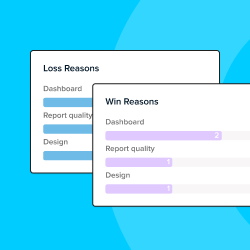
Data shows that teams conducting these interviews see a 14.2% increase in win rates. Our internal data also confirm this as they surface the true drivers behind a purchase decision, while call recordings show how buyers describe competitors in their own unvarnished words.
But manually tracking these mentions across dozens of 45-minute Gong calls is a slow, agonizing process. Without the right system, you are forced to spend your entire week doing discovery rather than building enablement materials.
Purpose-built automation changes your daily workflow. For instance, Klue’s Compete Agent runs entirely in the background to generate the core insights your GTM team needs.
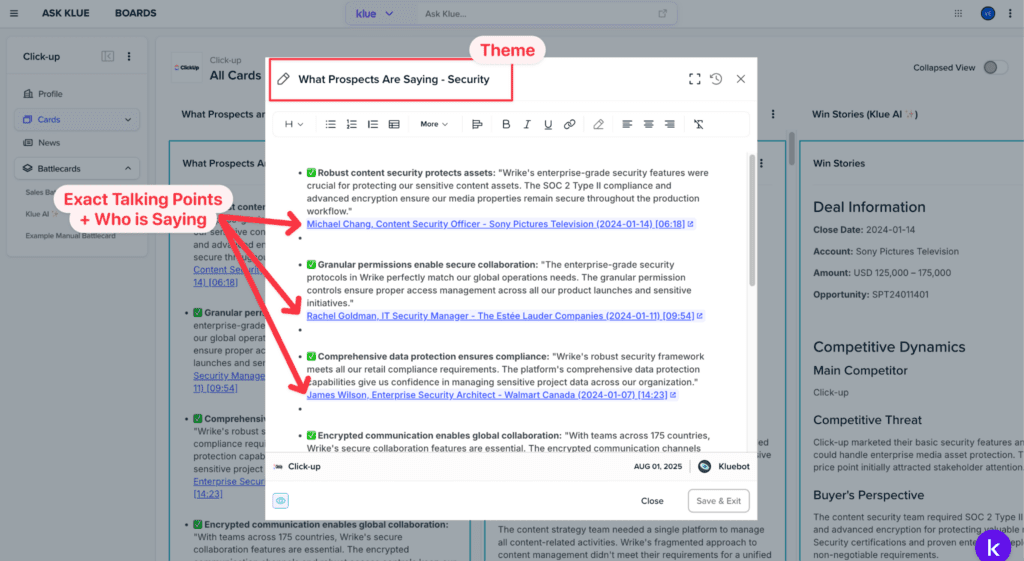
By connecting call recording software like Gong to Klue’s Compete Agent, you automatically uncover hidden competitive signals. The system identifies every competitor reference across all sales calls without requiring external trackers or manual tagging. It pulls the real evaluation criteria from live conversations and packages them into “What Prospects Are Saying” cards:
Guy Larcom, a PMM at Emburse, faced this exact bottleneck:
“We have a ton of competitors with lots of similarities. Tracking what prospects are saying, what’s driving them to look for change beyond just a contract being up — that was the biggest challenge for me.”
With What Prospects Are Saying, Guy stopped digging through Slack alerts. He used verified buyer quotes to see what was driving outcomes in real time and fed that deep insight directly into his messaging.
2. Evaluate strengths and weaknesses truthfully
Once you know what buyers care about, you need to map out where a specific competitor is genuinely strong and where they leave themselves vulnerable.
You must build a comparison across the dimensions that matter to your buyers:
| Area | What to analyze |
| Product/Features | Core capabilities, integrations, ease of use, gaps |
| Pricing | Tiers, packaging, contract terms, discounting patterns |
| Marketing | Content, SEO presence, ad spend, event presence |
| Customer experience | Support channels, onboarding, success programs |
| Market position | Brand perception, customer segments |
This comparison table allows you to evaluate a competitor’s core product capabilities, specific pricing tiers, contract terms, marketing presence, and customer success programs. But you must be honest. Pretending competitor strengths do not exist leaves your sellers blind-sided in live negotiations.
Generic open-source AI models can quickly summarize public information, but they introduce massive risk. Details like specific pricing tiers or packaging limitations generated by generic LLMs might sound convincing while being completely fabricated. Handing an Account Executive an AI-generated objection handler that turns out to be false will destroy your credibility with the sales floor for months.
Klue’s Auto Insights bypass this hallucination risk entirely.
The Pricing & Packaging insight automatically consolidates competitive pricing intel, cleans the data, and links every single claim directly back to a verified source:
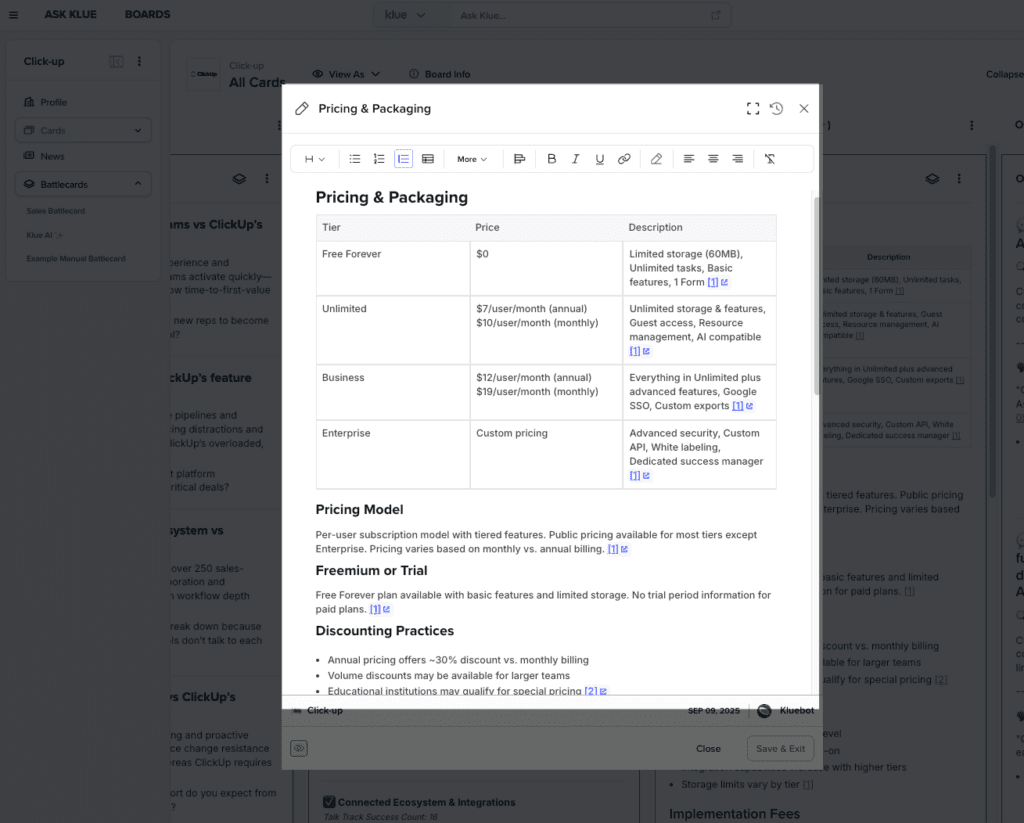
Every data point ties back to real deals and verifiable documents. You get an accurate, battle-tested view of their market position without the anxiety of manual data entry or AI hallucinations.
3. Extract the talk tracks that actually win
Giving sales raw data fails to move the needle.
Reps need sharp arguments and exact sales talk tracks they can deliver verbatim on a call.
The most effective objection handling techniques are usually locked inside the heads of your top 1% of sellers. You need a scalable way to extract those brilliant, in-the-moment responses and distribute them to the rest of the team. When a prospect drops a pointed objection about a competitor’s pricing structure, a rep with a stale marketing script will freeze.
But a rep armed with proven language?
They will pivot and advance the deal.
Klue translates raw call data into deal-winning objection handling. The “Talk Tracks That Win” Auto Insight automatically pulls the phrasing and positioning that top performers use to win, refreshing the data weekly so frontline enablement stays current:
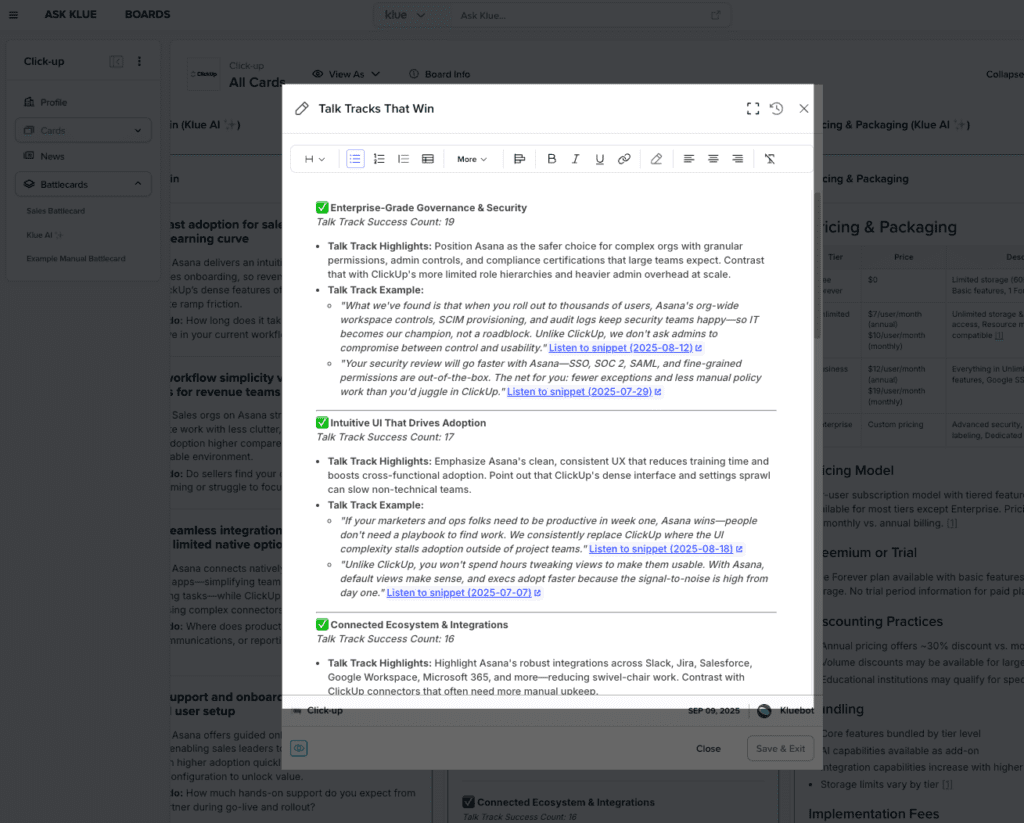
Dustin Ray at Huntress saw immediate adoption when he moved away from static, generic battlecards:
“The ‘talk tracks’ insight — updated regularly with what’s actually working — are phenomenal. Reps pick them up quickly, align to our messaging, and sales managers are using them in training to reinforce the right plays.”
Reps trust the material because they can physically hear their peers handling the exact objection successfully.
4. Push intelligence directly into the seller’s workflow
Here is where the vast majority of competitive programs fall apart. The analysis is solid. The battlecards look beautiful. And absolutely none of it reaches the rep before their next call.
Sales reps spend only 28% of their week actively selling. If your competitive content requires them to log into a separate portal or hunt through a shared drive, they will ignore it. Intel must show up in the workflow: Slack, Salesforce, email, or wherever your sellers already spend their time.
Deal-centric competitive intelligence focuses on delivering specific strategies directly to sellers at the exact moment they need them.
Using Klue’s Deal Tips, your sellers automatically receive personalized competitive briefings in their Slack, Salesforce, or email inboxes within minutes of a competitor being mentioned on a prospect call:
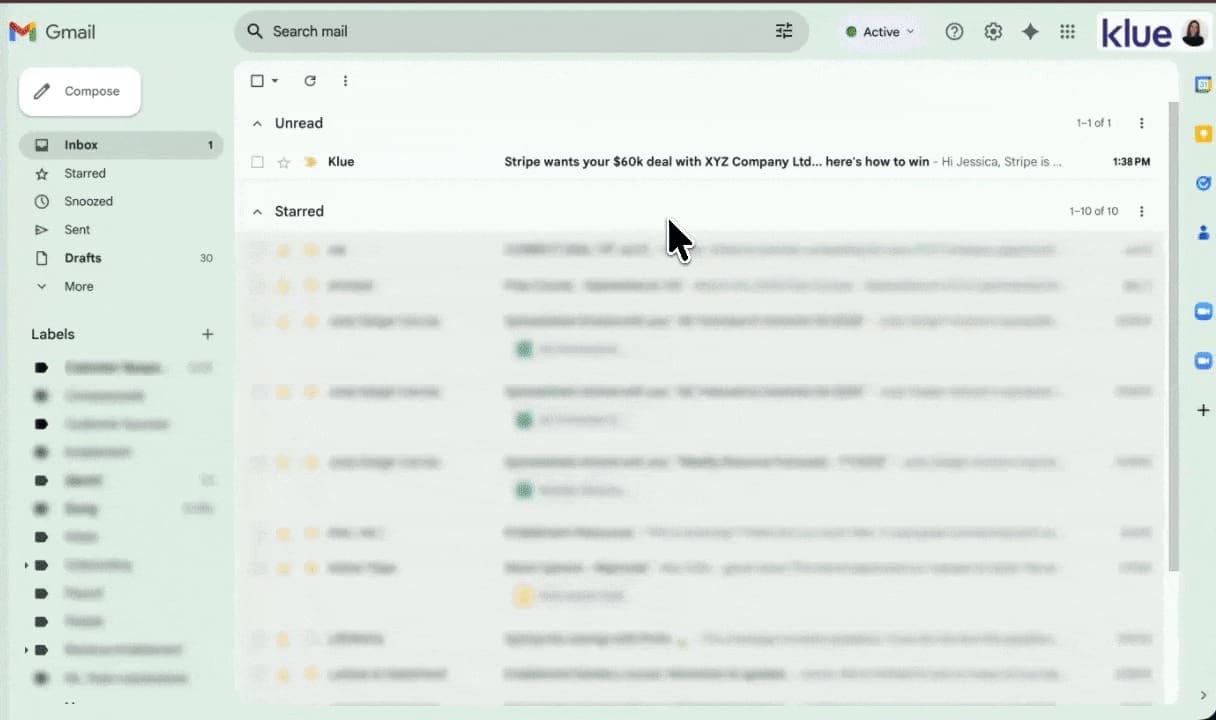
You step completely out of the manual routing process. Ask Klue acts as an instant competitive helpline accessible via email, Slack, or Salesforce. It searches across all your trusted competitive data sources to deliver precise answers within seconds.
As Mara Konrad, CI PMM at Greenhouse Software, put it:
“We built out a full battlecard with Auto Insights. So every time a rep opens it, they default to a fresh round-up of the automated insights: win/loss stories, pricing and packaging, objection handling, talk tracks that win, and what prospects are saying.”
Why competitive analysis matters for revenue teams
“We focus on the customer, not the competitor.”
You’ve probably heard this in a leadership meeting. It sounds strategic.
But here’s what we found after analyzing over 3,400 buyer interviews at Klue Labs: only 1.5% of deals had zero competitors involved. And on average, buyers evaluate 3.5 vendors per deal. Your buyer is looking at your competition whether you are or not.
Competitive analysis must function as a deal-winning engine—yet the average team rates its competitive selling readiness at just 3.8 out of 10.
Deep competitor analysis solves this in four ways:
- Seller confidence: Reps who know specific competitor weaknesses handle objections without hesitating
- Win rate impact: Teams with current intel on their top rivals close more deals against named competitors
- Pricing defense: Knowing a competitor’s pricing prevents unnecessary discounting
- Faster deal cycles: In-depth competitive analysis leads to proactive positioning, which, in turn, reduces the back-and-forth that stalls buying decisions.
Tools for competitive research and analysis
Market intelligence and news monitoring
Google Alerts, Feedly, and news aggregators monitor competitor announcements and press coverage. Free or low-cost starting points for staying current.
SEO and marketing analysis tools
SEMrush, SimilarWeb, and Ahrefs reveal competitor traffic, keywords, and content. Useful for understanding competitor marketing investments and identifying gaps.
Competitive intelligence platforms
Dedicated platforms centralize intel, automate research, and deliver insights to revenue teams. The best option for teams that want to scale competitive coverage without adding headcount.
For instance, Klue’s Competitor Profiles let you generate complete, auto-refreshing intelligence on any competitor by searching their name. For deeper analysis, Ask Klue Research Mode runs complex queries across all your data sources, including win-loss interviews and call recordings.
Scale Your Compete Program, Not Your Headcount
Building a deep competitive analysis on a top competitor should never take weeks.
By using the suite of tools in Klue AI, you transition from being a manual curator of battlecards to a strategic advisor driving actual revenue. PMMs and CI Pros who adopt Klue AI increase competitive deal win rates consistently. Blackbaud lifted win rates by 28% against their toughest competitors using Klue’s Deal Tips and Win Stories. At Fleetio, Director of Product Marketing David Chan increased win rates by 5% just six months after rolling out Klue AI.
Stop chasing competitor website updates. Start fueling your reps with the exact intelligence they need to win the deal in front of them today.
Ready to see how Klue AI can automate your competitor analysis without adding headcount?
Request a demo to see the compete engine in action.
FAQs on how to do a Competitive Analysis
What are the five steps of a competitive analysis?
The five core steps are: identify your competitors, gather data on competitor products and pricing, analyze competitor strengths and weaknesses, conduct a SWOT analysis, and define your competitive differentiation based on the findings.
How often should you update your competitive analysis?
Refresh your competitive analysis quarterly at minimum. You must monitor key competitors continuously since pricing, messaging, and product changes can happen at any time. Using automated tools like Klue ensures your competitor profiles auto-refresh daily.
What is the difference between competitive analysis and market research?
Market research examines your overall market, customer needs, and industry trends. Competitive analysis focuses specifically on the companies you compete against for the same customers.
How do you measure the ROI of a competitive intelligence program?
Track your competitive win rate against specific competitors over time. You should also measure battlecard usage by your sales team and collect qualitative feedback from reps on whether the provided intel actively helped close their deals.


SHARE THIS POST