Good Sales Battlecard Examples: What Works and Why in 2026
By Victor Eduoh 10 min read April 28, 2026
As Product Marketers and Competitive Intelligence pros, we constantly worry about our competitive intel going unused. And it’s painful. After all the work we put into building battlecards and the maintenance dread of keeping them up to date, reps just ignore them.
But what if that’s a sign of a deeper problem?
Sellers will always come back to your battlecards if it helps them win deals.
When your sellers are evaluating three or four competitors in every deal, they don’t need a static, generic feature matrix. They need specific arguments and talk tracks unique to each competitor they can say verbatim to close the revenue in front of them.
For reps to trust your enablement content and actually use it, let’s look at exactly what makes a good battlecard, the types your team needs, and real examples of great ones.
What makes a good sales battlecard?
First, we all know a sales battlecard is a one-page reference document that gives sellers the intel they need to win competitive deals. The best battlecards are concise, scannable, and actionable. They focus on “Why We Win,” objection handling, and competitor weaknesses rather than listing product features.
Most battlecards fail because they try to be comprehensive. They pack in every feature comparison, every data point, every possible objection. The result? A document no seller will read during a live call.
Great battlecards are ruthlessly focused on what helps sellers win.
Every effective card shares these foundational traits:
Contextual to the deal
The best battlecards tie to specific deal scenarios, not generic competitor facts. A seller doesn’t need a competitor’s founding date. They need to know what to say when the buyer mentions that competitor by name.
Structure content around “when the buyer says X, you say Y.” This scenario-based approach mirrors how sellers actually think during conversations.
Specific enough to use mid-call
Vague talking points don’t help anyone. Compare two approaches:
Weak: “We are more innovative than Competitor X.”
Strong: “When they claim faster implementation, ask: ‘Can you walk me through how your team handled the last three integrations that required custom API work?'”
The second version gives sellers exact language. That’s the difference between a battlecard that sits in a folder and one that wins deals.
Backed by real buyer evidence
The most credible battlecards pull from win-loss interviews and actual buyer quotes. When a seller can say “Here’s what a customer who evaluated both of us told us,” that carries more weight than any marketing claim.
Proof points from closed deals beat assumptions about why you win. — sellers and buyers disagree on loss reasons 50–70% of the time.
Contains proven sales talk tracks
You must equip sales reps with proven responses drawn from real call data. AI talk tracks are field-tested sales messages automatically surfaced from winning conversations in your own call recordings, guaranteeing your reps are using arguments that actually work.
Types of sales battlecards your team needs
Not every team needs every type of battlecard. The right mix depends entirely on your competitive landscape and sales motion.
Battlecard Type
Best For
Primary Use Case
Competitor battlecard
Head-to-head deals
Positioning against a specific rival and planting landmines
Objection handling battlecard
Common pushback
Responding to pricing, feature gaps, or implementation fears
What prospects are saying battlecard
Market validation
Understanding current buyer sentiment and recent market shifts
Product battlecard
Multi-product orgs
Selling a specific solution or module effectively
Why we win battlecard
Late-stage deals
Reinforcing your core differentiators with concrete buyer proof
Pricing & Packaging battlecard
Budget discussions
Defending value, explaining ROI, and justifying total cost of ownership
What Are Good Sales Battlecard Examples Worth Copying?
When your sellers are working a deal, they’re battling specific competitors, not the entire industry. Let’s look at specific formats that actually work. I will also walk through how to build these without trapping yourself in an endless cycle of manual updates by showing you exactly how these are built automatically through Compete Agent and Auto Insights inside Klue.
1. The Competitor Battlecard Example
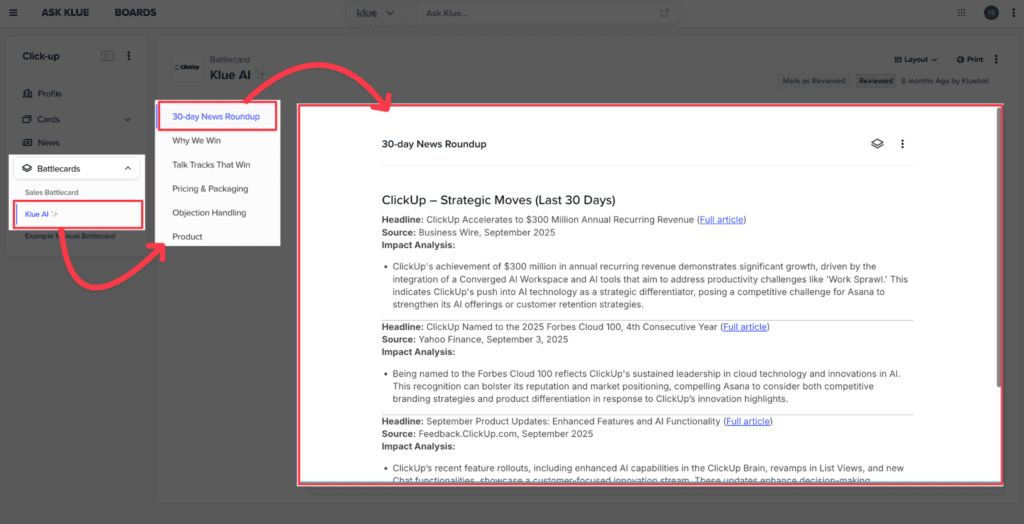
A strong competitor battlecard acts as the ultimate quick-glance cheat sheet for reps jumping into a critical sales call. In Klue, this battlecard refreshes every single day. It provides a highly summarized view of the competitor’s recent news alongside a succinct breakdown of why we win against them, the talk tracks that enable that win, high-level pricing, objection handling, and product overview:
What makes this specific example “good” is the absolute trust it builds with sales. Because it is updated daily with verified external intelligence and actual data from your own sales floor, reps know they are looking at the reality of the market right now, today.
2. The Objection Handling Battlecard Example
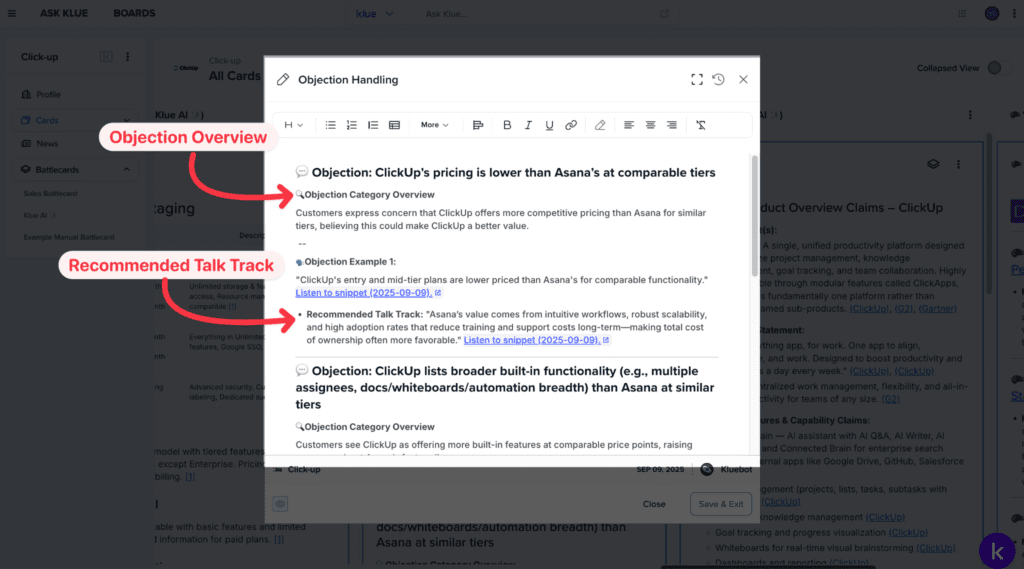
This card breaks down exactly how to handle the critical objections that stall deals across pricing, functionality, and core capabilities. Inside Klue, reps see a specific objection overview, followed immediately by exactly how buyers actually frame that objection in the real world.
The magic happens right below that:
As shown above, the card embeds proven talk tracks for handling those specific objections. Reps can literally listen to how your top performers successfully navigated that exact pushback in a recent deal. Supplying the exact, battle-tested words that win is what makes this card indispensable to a seller.
3. The What Prospects Are Saying Battlecard Example
Sellers need to know the current market narrative before they get blindsided.
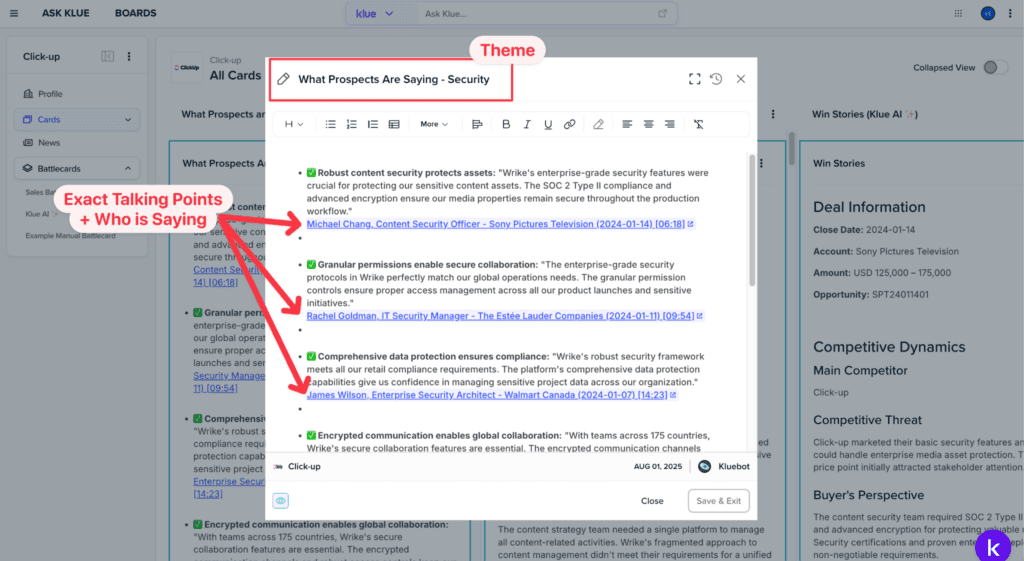
This battlecard groups what prospects are actively saying about a competitor relative to core capabilities—like security, AI automation, cost value, or the company’s reputation.
A great version of this card, like the one generated by Klue Auto Insights, allows reps to see exact quotes grouped by these core themes. Even better, they see exactly who said what—complete with the buyer’s specific title:
This level of granularity allows sellers to zero in on the insights most relevant to the specific deal they are working on, preparing them for the exact themes a particular buyer persona will likely bring up.
4. The Product Battlecard Example
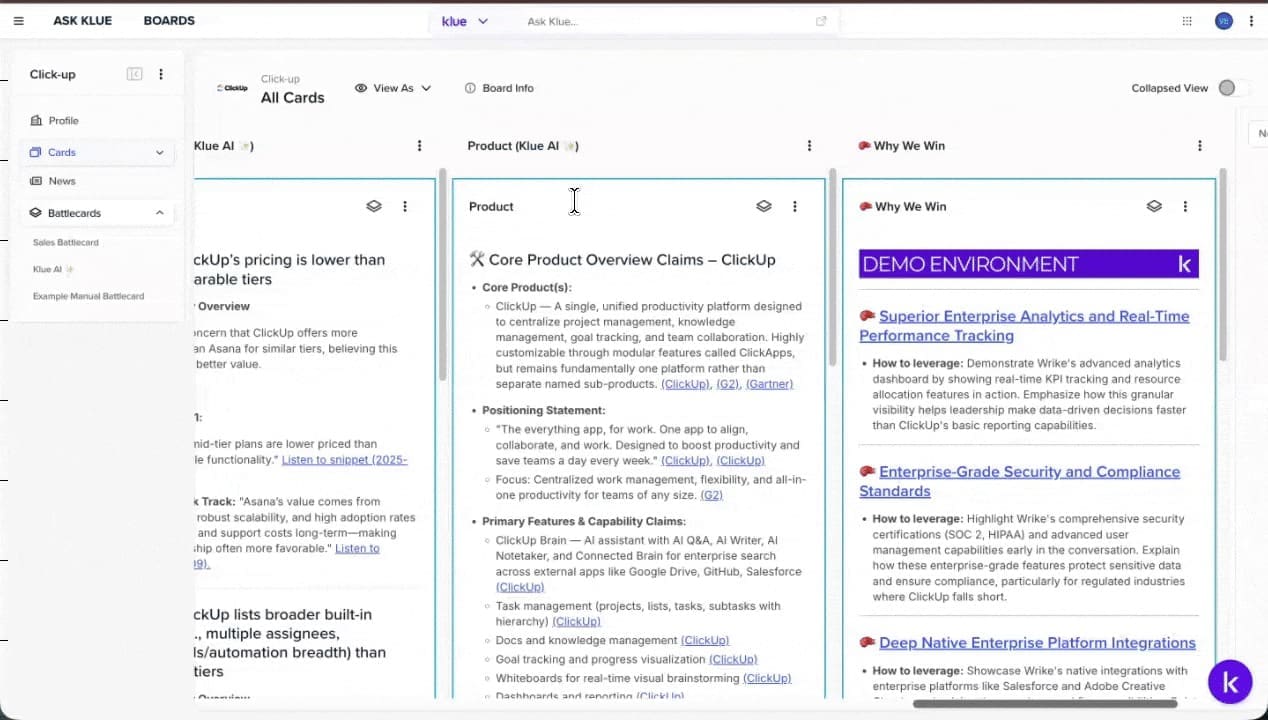
The goal here is to prevent cognitive overload while ensuring technical accuracy. At a glance, a good product battlecard shows reps the competitor’s core product overview, positioning statement, primary features and capability claims, integrations, partnerships, recent product news, and security and compliance standards:
Just like the competitor overview, what makes this format worth copying is the daily update mechanism. Klue’s Compete Agent ensures sellers always have the most recent data on new feature launches or integration updates. It summarizes the noise into actionable insights, ensuring the rep has technical credibility without having to read a 40-page product manual.
5. The Why We Win Battlecard Example
This format lists the capabilities and unique offerings that consistently give your company an edge over a specific rival in late-stage deals.
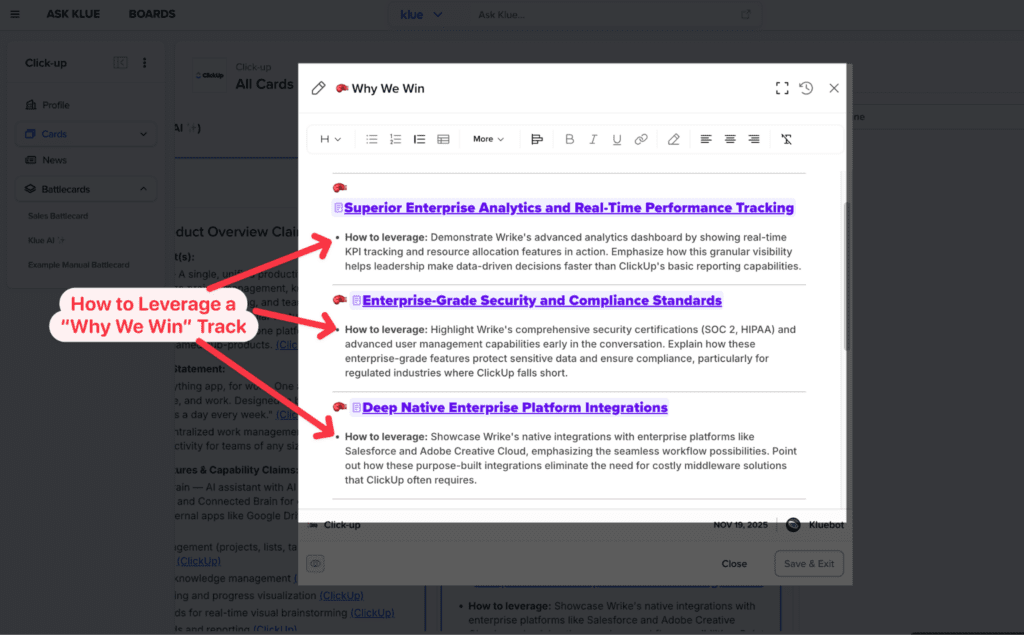
A highly effective “Why We Win” card features a succinct headline capturing the unique capability, followed immediately by instructions on how sellers can leverage it against that specific competitor:
Klue automatically pulls this data from Win/Loss stories, meaning the strategies are grounded in reality, and not just internal marketing assumptions:
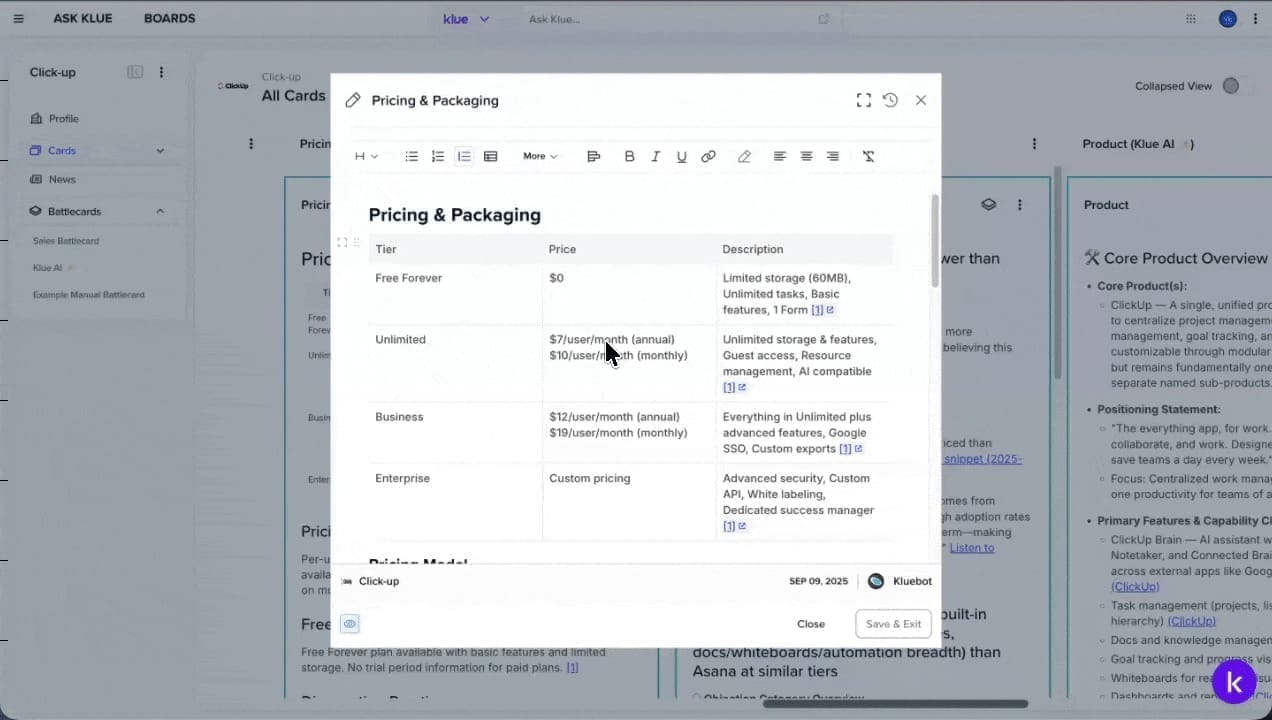
6. The Pricing and Packaging Battlecard Example
When budget discussions happen, sellers need total confidence. This card arms sellers with how to position your company’s pricing and offer packaging against a competitor.
A strong pricing battlecard features an always-updating table showing the competitor’s tiers, prices, and descriptions. It follows up with details on their pricing model (e.g., freemium vs. trial), discounting practices, bundling strategies, implementation fees, Total Cost of Ownership (TCO), and the overall market pricing perception. Giving reps this full financial picture ensures they never get backed into a corner purely on list price.
And these come pre-built in Klue AI:
How to create a good sales battlecard
1. Understand your users & use cases
BDRs need different content than AEs or sales engineers. A battlecard built for discovery calls looks different from one built for technical deep-dives. Start by defining who will use the card and in what context it would be used (i.e., the specific use case)..
2. Gather intel from internal and external sources
Gathering info from trusted external sources is a must. But the best competitive intel often lives inside your organization. Combine CRM data, sales call recordings, and win-loss interviews with external market research. Internal sources frequently hold insights that public research misses.
3. Focus on deal scenarios not feature lists
Structure content around real conversations. “When the buyer says X, you say Y” beats a feature comparison table every time. Sellers think in scenarios, not spreadsheets.
Stale battlecards lose credibility fast. Build a process for regular updates whenever competitor positioning, pricing, or product changes. Quarterly reviews are a minimum. And with a platform like Klue, you get Compete Agent working 24/7 behind the scenes to keep your cards always updated.
And that’s why Dustin Ray, Head of Competitive & Market Intelligence at Huntress, loves using Klue.
“When we look at the Klue-generated Auto Insights cards, the information is so new and so fresh. We draw out the exact points we need to hit and focus on. Once vetted, I drop it right out to the sales team as a whole. Or we share it with our product and engineering teams. It makes us way more nimble as a complete team.”
How to drive sales battlecard adoption
Creating battlecards is the easy part. Getting sellers to actually use them is the challenge.
Make battlecards easy to find in existing workflows
Store cards where sellers already work. 42% of sales reps feel overwhelmed by too many tools, so if reps have to leave their CRM or Slack to find intel, they won’t. Integration into existing tools matters more than having a beautiful standalone repository.
Surface battlecards at the moment of need
Proactive delivery beats reactive searching. The best sales enablement battlecards appear automatically when competitors are mentioned in deals.
Using Klue’s Deal Tips, sellers automatically receive personalized competitive briefings within minutes of a competitor being mentioned on a call. No searching required.
Mara Konrad, Competitive Intelligence Product Marketer at Greenhouse, saw her team record amazing wins in record time by leveraging Klue’s Deal Tips:
“We’ve had some amazing wins come through. Rep confidence has been a really big component. The Deal Tips lands in their inboxes and just does it all for our reps and it’s deal-specific. It gives them exactly what they need to follow up on with their prospect. It also gives them the call snippet and the ability to continue to ask questions through Ask Klue.”
Measure and share usage wins
Track which battlecards get used and correlate usage with win rates. When you can show that reps who use battlecards win more competitive deals, adoption follows.
How AI generates competitive battlecards instantly
Manual battlecard creation doesn’t scale. By the time you’ve finished researching a competitor, their positioning may have already changed.
AI can draft battlecards from your competitive data in minutes rather than days. That’s why 60% of CI teams now use AI daily. The key is grounding AI in your actual company context, not generic internet data.
Klue’s Compete Agent generates competitive battlecards from your existing intel automatically. It pulls from your Knowledge Hub, win-loss interviews, and sales call recordings to create cards that reflect your specific positioning and buyer feedback.
For quick competitive questions, Ask Klue provides instant answers that can populate battlecard content. Sellers can access it directly from Slack or Salesforce.
However, if we are being completely honest, you do not really need templates anymore.
When you use Klue, the product does all the heavy lifting. Compete Agent and Auto Insights automatically generate the core competitive intel, the structured layouts, and the proven talk tracks. Your job shifts from being a data-entry clerk to a strategic editor. You simply review the auto-generated cards, vet the insights, add your unique strategic POV, and make them instantly available to your reps via Deal Tips.
From battlecard to closed deal
A battlecard should function as a living asset that connects competitive intelligence directly to revenue. Ultimately, the question your reps need it to answer is, “What does this specific buyer need to hear to choose us over the alternative now?“
So next time you’re reviewing a competitive deal, try flipping the frame: What did the seller actually need to know in that moment? Did they have it? How do we deliver that insight before they even ask?
Guided by those questions, you’d build a good sales battlecard that actually helps your reps increase win rates and grow revenue.
Update battlecards whenever competitor positioning, pricing, or product changes. Most teams review cards quarterly at minimum, with ad-hoc updates triggered by new competitive intel from win-loss interviews or market shifts.
What is the ideal length for a sales battlecard?
One page is the standard. If sellers can’t scan a battlecard in under 60 seconds, the card is too long. Brevity forces prioritization, which is exactly what sellers need during live conversations.
How do I measure whether my battlecards are working?
Track battlecard views or downloads, then correlate usage with competitive win rates. Seller feedback surveys also reveal whether cards are useful. The ultimate metric is whether win rates against specific competitors improve after battlecard deployment.
What is the difference between a battlecard and a competitive comparison?
A competitive comparison is typically a feature-by-feature breakdown, often buyer-facing. A battlecard is an internal sales tool with positioning guidance, objection handling, and talk tracks designed for the seller, not the buyer.

















SHARE THIS POST